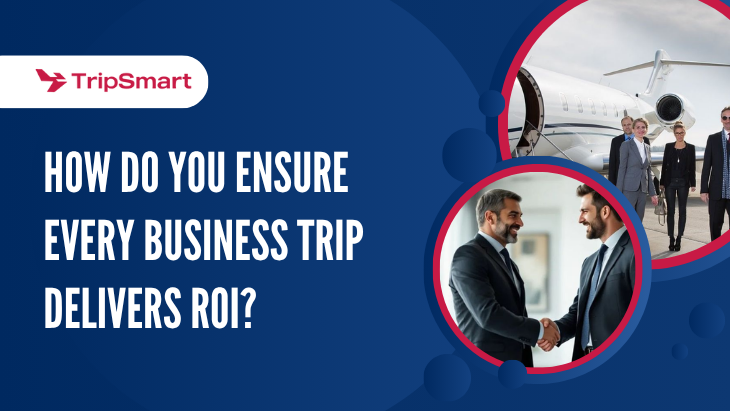


Business travel continues to be a special value in a world where virtual meetings have become the new reality of Business Travel & Expense Management. The proper business trip can provide extraordinary returns, whether that is in partnerships, deals, market research, or team relationship building. Nevertheless, the price of business travel remains on the increase- and it is important that companies should consider all travel as an investment and not an expenditure.
To do so, companies will need to be smarter in their planning, goal-setting, and Business Travel and Expense Management. This is how the executives of a business can make sure that every trip will give a quantifiable ROI.
Begin With a Good Reason for the Trip.
A business trip that lacks a purpose is like sailing without a compass. Prior to the travel, define what objectives the travel is supposed to fulfill. Questions to ask include:
★ What is the expectation of the result of this trip?
★ Does this meeting have a strategic significance?
★ Is it possible to have this interaction virtually?
★ What are the indicators of success?
As an illustration, when a salesperson is meeting a customer, the measure of success could be in closing the sale, volume of order, or renewing the contract. When the employees understand what they should get, they would build their itinerary more efficiently, communicate more efficiently, and be outcome-centered, not activity-centered.
Select Economic Travel Solutions and Do Not Sacrifice on Productivity.
Travel does not necessarily involve getting the lowest price ticket, but rather getting the best ticket. A poorly developed itinerary or the quality of stay may ruin performance, energy, and client relationships. ROI is the result of cost-effectiveness, comfort, and productivity.
Cost optimization can be maximized by companies in the following way:
★ Book your flights and hotels beforehand in order to get better rates.
★ Make use of corporate vendors who have negotiated discounts.
★ Select rooms near the locations of meetings to eliminate travelling.
★ Use flight and hotel loyalty programs.
It is long run better than an overworked employee who comes in on time and works well to generate more ROI than someone tired of having to travel comfortably.
Power Teams With Intelligent Business Travel and Expense Management Solutions.
The present-day organizations are highly dependent on online resources to facilitate the traveling process. A Business Travel and Expense Management system has all the booking, expense tracking, reporting, and travel policies centralized in a single place.
★ Benefits include:
★ Real-time expense tracking
★ Automated receipt of receipts.
★ Policy-compliant bookings
★ Reduced days to first payment.
★ Open expenditure patterns.
As technology takes the administrative burden, the employees can concentrate on providing results. In the meantime, finance departments become more aware of travel expenses, and executives can evaluate ROI on their trips, detect trends, and identify leakage.
Develop a successful pre-trip strategy.
Any successful business trip is based on good planning. The employees are to develop a planned itinerary that includes:
★ Client or partner meetings
★ Networking sessions
★ Market visits
★ Research activities
★ Travel time buffers
★ Contingency plans
An effective schedule can guarantee an efficient utilization of time by the employees and prevent the last-minute hustle. The better the trip is planned, the greater the probability of producing significant outcomes.
Prominence on Data-Driven Decision-Making.
Without data, ROI is impossible to measure. Companies are supposed to monitor after every trip:
★ Income from transactions made.
★ New opportunities created
★ Fine-tuning of client relationships.
★ Market insights collected
★ Cost savings realized
★ Brand visibility achieved
Having a complete Business Travel and Expense Management solution, companies will have an opportunity to examine the tendencies of traveling and determine which trips yield positive results regularly. This assists the business leaders in determining which travel activities to maintain, modify, or scale back.
Correspondence of Travel Policies and Business Objectives.
The conventional travel policies merely limited the budget and determined the type of hotel that employees could book. The current travel policies, however, are supposed to be in correlation with the strategic business objectives. A policy that is too strict is demoralizing to the employees, and excessively loose results in unwarranted costs.
An effective policy should:
★ Determine when travelling is required.
★ Give guidelines on permissible expenditures.
★ Established rules on window bookings.
★ Promote efficiency and security.
★ Connect with automated costing.
★ Developing a good travel policy will make it stable and give the employees the right to make responsible travel choices.
★ Focus on Traveler Well-Being
An overworked or stressed employee can not perform strongly. The welfare of the employees is directly connected to the outcomes of the business. Companies can enhance ROI by:
★ Provision of flexible travelling plans.
★ Rest time after the long flights.
★ Provision of health and safety assistance.
★ Quality accommodation.
★ It is better to avoid flying at red-eye hours without any necessity.
Employees who feel important and well taken care of are better motivated, professional, and productive whenever conducting business engagements.
Enhance the Post-Trip Activities.
When the employee went back home, he did not stop the trip, but the results did. To guarantee ROI, employees are to:
★ Report on follow-up outcomes.
★ Email post-meeting clients and partners.
★ Share market knowledge with internal departments.
★ Put new opportunities into CRM.
★ Suggestions on how to do the next trip.
This post-trip will guarantee that there is no loss of momentum and that the opportunities developed in the trip will result in quantifiable business development.
Measuring ROI in a Simple Formula.
Although qualitative benefits are inherent to every trip, ROI can be quantified by the companies as well:
ROI = (Revenue Generated- Travel Cost)/ Travel Cost x 100
New deals, renewals, partnerships, or potential future business may serve as sources of revenue generated. Even the knowledge obtained on the trip can be implemented into a measurable value in the long run.
Conclusion
To achieve ROI of all business trips with Tripsmart, there should be a balance between strategy, technology, planning, and the well-being of the employees. By implementing smarter Business Travel and Expense Management systems, having specific goals, and concentrating on significant deliverables, business travel proves to be a robust growth engine rather than a fixed operational expense.
Being purposeful and structured, companies will be able to make every trip a worthwhile investment capable of building relationships, creating opportunities, and propelling success in the long term.


Leave a reply